
What Generation Can Actually Come Online in Time?

In the first article of this series, The Missile and the Meter, I traced the direct line from Iran’s missile strikes on Qatar’s Ras Laffan LNG complex to the power bills of families in North Carolina. The mechanism is not abstract. It is arithmetic. Global gas prices rise, Duke Energy’s fuel costs rise, and those costs flow directly through to ratepayers via the annual fuel rider. Two-thirds of residential rate increases for Duke Energy Carolinas customers since 2017 have come from gas fuel costs alone.
The response I heard most often after publishing that piece was some version of the same question: So what do we do about it?
That question has an answer. It is not speculative. It is not waiting on a technology breakthrough. And it does not require a decade of regulatory proceedings. The answer is that we build the technologies that are ready now, that carry no fuel cost risk, that create jobs in the communities where they are deployed, and that can reach the grid before the next crisis hits.
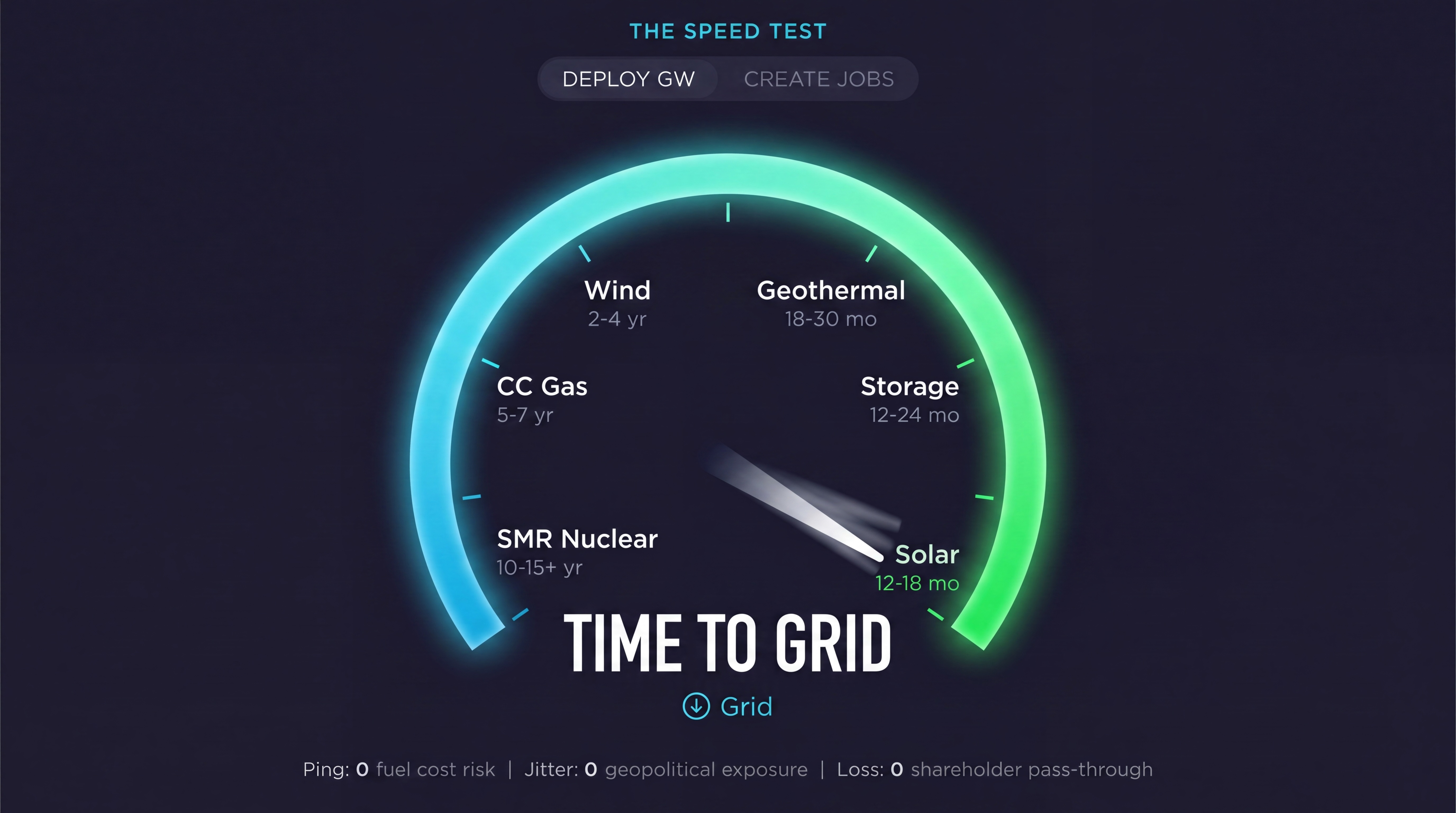
This article is a speed test. Not every clean energy technology can pass it.
The Demand Is Not Waiting
Before we compare technologies, we need to understand what we are racing against. Electricity demand in the United States is growing at a pace not seen in two decades, driven by data center construction, manufacturing reshoring, building electrification, and the slow-motion retirement of aging coal and gas plants. North Carolina sits at the center of this acceleration. Duke Energy’s own filings acknowledge surging demand across its Carolinas service territory.
At the same time, the global LNG disruption from the Iran-Gulf conflict is entering its third month. Qatar’s Ras Laffan complex will be structurally impaired for three to five years. U.S. natural gas prices spiked 20% in March. Brent crude briefly touched $119 a barrel. European benchmark gas prices have doubled since the war began. Every month that passes without new clean generation capacity coming online is another month that ratepayers are exposed to a global fuel market that is more fragile, more expensive, and more volatile than it was a year ago.
The question is not which technology is theoretically ideal. The question is what can get permitted, built, connected to the grid, and creating local jobs on a timeline that matches the urgency of this moment.
The Speed Comparison: From Groundbreaking to Grid
| Technology | Time to Grid | 2026 U.S. Planned Capacity | Fuel Cost Risk | Local Job Creation Speed |
|---|---|---|---|---|
| Utility-Scale Solar | 12–18 months | 43.4 GW | None | Immediate |
| Battery Storage | 12–24 months | 24.3 GW | None | Immediate |
| Community Geothermal | 18–30 months | Emerging | None | Immediate |
| Combined-Cycle Gas | 5–7 years | 6.3 GW | Extreme | Delayed |
| Small Modular Nuclear | 10–15+ years | 0 GW | Low (fuel) | Decade+ |
Read that table carefully. The U.S. Energy Information Administration reports that developers plan to add 86 gigawatts of new utility-scale generating capacity to the American grid in 2026 alone, the largest single-year addition in over two decades. Solar and battery storage account for 79% of all planned additions. Renewables and storage together account for 93%. Natural gas accounts for just 6.3 gigawatts. And small modular nuclear accounts for exactly zero.
In 2026, developers plan to add 43.4 GW of new solar and 24.3 GW of new battery storage to the U.S. grid. Combined, that is nearly 68 GW of clean, zero-fuel-cost capacity. Natural gas is adding 6.3 GW. The market has already voted.
Source: U.S. Energy Information Administration, Electric Power Monthly, February 2026
These are not projections from advocacy groups. This is the federal government’s own data on what is actually being built right now. The market is not confused about which technologies can deliver capacity fast enough to matter. The confusion exists only in utility boardrooms and statehouse hearing rooms where legacy business models and political ideology still dictate resource planning.
The Nuclear Conversation We Need to Have Honestly
I want to be careful here because I am not an opponent of nuclear energy in principle. It has a role in a decarbonized grid. What I am opposed to is dishonesty about timelines, and I am seeing a lot of it in my network.
Duke Energy filed an early site permit application with the NRC in December 2025 for potential small modular reactors at the Belews Creek site in Stokes County. The company’s own stated timeline is to have the first SMR operational by 2036, with 600 megawatts of capacity online by 2037. That is a decade from now. And that timeline assumes everything goes right.
Here is what the track record actually looks like. NuScale Power’s Carbon Free Power Project in Utah, which was the most advanced SMR project in the United States, was cancelled in 2023 after costs ballooned from an estimated $5.3 billion to $9.3 billion. Plant Vogtle in Georgia, the last conventional nuclear expansion in the U.S., came online seven years late and roughly $17 billion over budget. Duke Energy itself has abandoned 19 separate nuclear projects over its corporate history.
Nobody in the energy community should be attacked for stating the obvious: if your electricity demand is growing now, and your ratepayers are being hit by gas price volatility now, and the technology that can come online in 12 to 24 months is solar and storage, then steering billions of dollars toward a technology that might produce its first commercial electron in 2036 is not a serious response to the crisis. It is a deferral dressed up as a solution.
If Duke Energy broke ground on a small modular reactor tomorrow, the earliest it could serve a North Carolina customer is 2036. If Duke broke ground on a solar-plus-storage project tomorrow, it could be serving customers by 2027. That is not a close call.
Source: Duke Energy ESP filing, December 2025; EIA Electric Power Monthly, February 2026.
Speed Is Not Just About Megawatts. It Is About Jobs.
Here is the part of the speed conversation that too many clean energy advocates leave out, and it is the part that matters most to the communities I work with in Eastern North Carolina.
Technologies that come online fast also create jobs fast. And if they are community-scale projects built with intentional workforce development, those jobs stay local.
Right now, in Enfield, North Carolina, population 2,300, we are building what will be the South’s first community-led networked geothermal demonstration. The Enfield Networked Geothermal Project will install HDPE main, drill boreholes, and convert buildings from conventional heating and cooling to ground-source heat pumps. This is not a pilot study. It is a construction project with a defined scope and timeline, funded in part by a BuildUS award.
But the pipes going underground are the easy part. The harder, more important question is whether the people who live above those pipes will own the work, the wages, and the wealth this transition creates.
That is why Enfield Energy Futures and The Alluvial are developing a three-track apprenticeship framework alongside the construction project. Track 1 builds a youth pipeline. Track 2 delivers an adult apprenticeship serving unemployed and underemployed Halifax County residents, with stackable certifications. Track 3 sustains the community engagement and recommendation infrastructure that ensures the people who need this opportunity most are the ones who get it.
The solar and clean energy industries face a projected workforce gap of 53,000 positions by late 2026. Halifax County has an unemployment rate of 6.2%, nearly double the state average. These two facts are not unrelated. They are an opportunity that intentional policy should connect.
Sources: pv magazine/IREC, April 2026; U.S. Census Bureau, Halifax County Quick Facts
A successful apprenticeship model in Enfield becomes a blueprint that every community can adopt. The curriculum, the partnership structures with community colleges, the college pipeline, the community engagement protocols: all of it is being designed for portability from the start, released so any community can use it.
The Real Bottleneck Is Not Technology. It Is Policy.
I want to be honest about the obstacles solar and storage face, because credibility matters.
The single biggest constraint on solar and storage deployment is not the technology. It is the interconnection queue. Across the country, solar and storage projects wait years for grid connection approvals, trapped in a process that was designed for a world of centralized power plants, not distributed generation. FERC’s interconnection reforms are underway but moving too slowly for the pace of deployment. In North Carolina, projects in Duke Energy’s territory face interconnection timelines that can stretch to three years or more, even for shovel-ready projects.
But this is a policy problem, not a technology problem. And the solution is transmission reform, queue management, and regulatory modernization, not abandoning the fastest, cheapest resource and substituting a slower, more expensive one. The fact that the highway is congested is an argument for building more lanes, not for replacing cars with something that takes a decade to manufacture.
Community-scale projects have an additional advantage here. Municipal microgrids, rooftop solar, community solar, and behind-the-meter storage can often avoid the worst interconnection delays because they serve local load directly. This is exactly why community-driven models like Enfield’s matter: they operate at a scale where the infrastructure-to-grid pathway is simpler, the local economic benefit is immediate, and the community retains control.
The 53,000-Worker Gap Is an Invitation, Not a Barrier
Earlier this spring, pv magazine reported that the U.S. solar industry faces a projected shortage of 53,000 workers by late 2026 as developers race to meet construction deadlines. The industry needs approximately 355,000 workers to support installation targets of 60 to 70 GW. It currently has 280,000. Meanwhile, 86% of solar employers report difficulty filling open positions.
Under federal apprenticeship mandates tied to the Section 45Y and 48E tax credits, projects must ensure that 15% of total labor hours are performed by qualified apprentices to secure the full credit value. Yet only 43% of the current workforce has access to the training infrastructure needed to fill those roles.
Read those numbers alongside the unemployment data from Eastern North Carolina. Halifax County’s unemployment rate is 6.2%. Enfield’s poverty rate is 28%. These communities have workers. What they do not have is the training infrastructure, the apprenticeship pipelines, and the project pipeline that would connect available people to available work.
This is not a workforce gap. It is a policy failure. And it is a policy failure that community-driven clean energy projects are uniquely positioned to solve, because they build the training infrastructure and the project pipeline simultaneously, in the same place, for the same people.
In North Carolina, an apprenticeship framework should not be a standalone workforce program bolted onto a construction project after the fact. It must be designed from the ground up so that the construction of the geothermal system becomes the training ground for the workforce that will maintain, expand, and replicate it. The people who dig the trenches learn HDPE fusion welding. The people who assist on drilling rigs earn certifications that transfer to the next community’s project. The wealth compounds.
The Speed Test Verdict
If you are an advocate, a regulator, an elected official, or a ratepayer who wants to know what can actually be done about rising energy costs and surging demand, here is the honest answer.
Solar and battery storage can be built and generating electricity within 12 to 24 months. Community-scale geothermal can be online within 18 to 30 months. Both carry zero fuel cost risk. Both create local jobs immediately. Both can be scaled across communities with portable training infrastructure and open-source curriculum.
Combined-cycle gas plants take 5 to 7 years and lock ratepayers into decades of fuel price exposure to global commodity markets now being shaped by missiles in the Persian Gulf. Small modular reactors are a decade away on the most optimistic reading and have a track record of cancellations and cost overruns that should give any serious planner pause.
For every dollar Duke Energy proposes to spend on new gas generation, ask how many megawatts of solar and storage that same dollar could bring online, and how much sooner. For every year Duke asks ratepayers to wait for a nuclear reactor that may never materialize, ask how many apprentices could have been trained, how many panels installed, how many batteries commissioned, and how many families freed from the fuel rider.
The technologies that pass the speed test are the same ones that pass the cost test, the jobs test, and the sovereignty test. They are solar, storage, geothermal, efficiency, and demand response. They are available now. The only things moving slowly are the institutions that should be deploying them.
It is time to stop waiting for technologies that are not ready and start building the ones that are. It is time to stop pretending that a reactor that might generate its first electron in 2036 is a responsible answer to a family that cannot afford its electric bill in 2026. And it is time to stop allowing the narrative to be captured by actors whose business model depends on building expensive infrastructure slowly rather than deploying affordable infrastructure fast.
The speed test has a clear winner. The question is whether we have the political will to act on what the data is telling us.
This is the second article in The Price of Dependence, a six-part series from The Current examining how geopolitical volatility, utility business models, and federal policy failures are converging to raise energy costs for North Carolina families, and what a different path looks like.
Next: Article 3: The Trap, How Slashing Clean Energy Credits Locked Americans Into Rising Costs
William Munn III, PhD is the founder and principal of The Alluvial, LLC, a consultancy focused on community-driven clean energy, broadband, and regional economic development across rural North Carolina.


Leave a Reply