
How a Strike on Qatar Will Show Up on Your North Carolina Power Bill

Since the U.S.-Israel-Iran conflict began on February 28, 2026, Iranian missiles have struck Qatar’s Ras Laffan Industrial City multiple times. Ras Laffan is home to the largest liquefied natural gas export facility on earth. The initial drone strikes on March 2 forced QatarEnergy to halt all LNG production. Then, on March 18, a more devastating barrage hit the complex directly. Two of the facility’s fourteen LNG production trains and one of its two gas-to-liquids plants were severely damaged. Fires burned across multiple facilities. QatarEnergy’s CEO, Saad al-Kaabi, announced that 17% of the country’s LNG export capacity would be offline for three to five years. QatarEnergy declared force majeure on long-term contracts covering supplies to Italy, Belgium, South Korea, and China.
That sounds like a problem for Doha, or Brussels, or Seoul. It is not supposed to sound like a problem for Durham, or Shelby, or Enfield, North Carolina.
But it is. And every ratepayer in this state needs to understand why.
The Invisible Thread Between the Persian Gulf and Your Power Bill
North Carolina does not import LNG from Qatar. Our electricity comes from Duke Energy’s fleet of coal, nuclear, solar, and, increasingly, natural gas combined-cycle plants that burn domestically produced gas delivered through pipelines. So why should a missile strike in the Middle East matter to a family in Hoke County trying to keep the lights on?
Because the United States is now the world’s largest LNG exporter. When Qatar’s supply disappears from global markets, European and Asian buyers scramble to replace it. They turn to American exporters, who can now command premium prices on the global market. That pulls domestic U.S. gas prices upward. Even gas that never leaves American soil becomes more expensive because it could leave American soil. The global price sets the floor.
This dynamic is already playing out. In March 2026, a late-season arctic weather event (the “St. Patrick’s Day Freeze”) collided with the global supply shock from the Middle East conflict, sending U.S. natural gas prices up roughly 20% in a single week. The weather event was the primary short-term driver. But the geopolitical crisis amplified the spike by eliminating the cushion that surplus LNG export capacity would normally provide. When domestic production hiccups happen at the same moment global buyers are desperately bidding for American cargoes, the system has no slack.
Internationally, the impact has been staggering. Brent crude briefly touched $119 a barrel on March 19. European benchmark gas prices at the Dutch TTF have at various points nearly doubled since the war began on February 28, jumping from the low €30s to above €60 per megawatt hour. As of the most recent reporting, European prices remain 30 to 60 percent above pre-conflict levels, with significant day-to-day volatility. Wood Mackenzie, one of the world’s leading energy analytics firms, has declared that the damage to Ras Laffan “fundamentally alters the global gas market outlook.”
The U.S. Energy Information Administration’s March 2026 outlook projects that domestic Henry Hub prices will remain “relatively unaffected” in the near term. Industry advocates will cite this projection. But that forecast was completed on March 9, before the devastating March 18 strike on Ras Laffan. More importantly, it obscures the structural risk: as U.S. LNG export capacity continues to expand (the EIA projects feedgas demand rising to 16.7 Bcf/d in 2026, up from 15.1 Bcf/d in 2025), the linkage between domestic and global prices tightens. The real exposure is not about one month’s price spike. It is about three to five years of a structurally short global LNG market pulling American gas prices upward.
How Duke Energy’s Business Model Delivers the Shock to Your Doorstep
Here is the part that should concern every North Carolinian.
Under North Carolina’s regulated utility structure, Duke Energy passes fuel costs directly through to ratepayers via an annual fuel rider that the NC Utilities Commission adjusts each year. If natural gas prices rise, your bill rises. Duke’s shareholders do not absorb that volatility. You do.
In the Duke Energy Carolinas service territory, increases in gas fuel costs account for roughly 67% of the increase in residential retail rates since 2017, making the portion of the rate increases attributable to fuel costs more than double the amount from all other rate components. In the Duke Energy Progress territory, fuel costs account for roughly 46% of residential rate increases over the same period.
Source: EQ Research analysis commissioned by the Environmental Defense Fund, April 2024. The underlying data is drawn from Duke Energy’s own filings with the NC Utilities Commission.
Read that again. Two-thirds of the rate increases Duke Energy Carolinas customers have experienced over the past seven years are attributable to the cost of burning natural gas. Not to investments in grid reliability. Not to renewable energy mandates. Not to new transmission lines. To fuel. A commodity whose price is set by forces entirely outside the control of North Carolina families, regulators, or elected officials.
A North Carolina Court of Appeals recently found that the Utilities Commission improperly approved a Duke Energy fuel rate increase in 2024. The Public Staff, the state’s ratepayer advocate, requested a refund for customers. But the court declined, citing SB 266, the Power Bill Reduction Act (a name that should earn an award for legislative irony). That law, passed over Governor Josh Stein’s veto in July 2025, now allows Duke to make multi-year recoveries of fuel costs, insulating the utility’s revenue stream while ratepayers absorb every shock the global gas market delivers.
The Three-to-Five-Year Forecast: What Ratepayers Should Expect
Let us be honest about what is coming.
Qatar’s Ras Laffan complex will not be repaired quickly. Three to five years is the estimate from QatarEnergy’s own CEO. That means the global LNG market will be structurally short for the foreseeable future. European and Asian buyers will continue to compete aggressively for American LNG cargoes, keeping upward pressure on domestic gas prices, particularly during periods of high seasonal demand or weather-driven production disruptions like the one we just experienced.
Meanwhile, Duke Energy is doubling down. The company’s most recent resource plans for the Carolinas include substantial new gas-fired generation: large combined-cycle units at sites like Belews Creek and Marshall, alongside additional gas capacity elsewhere in its service territory. In November 2025, Duke filed for $1.7 billion in rate increases over two years: $1 billion from its Duke Energy Carolinas customers (a 15% increase) and $729 million from its Duke Energy Progress customers (a 15.1% increase). The company is pursuing one of the most aggressive proposals for new fossil power plant construction of any utility in the nation.

Every new gas plant Duke builds is a 30-year bet that global fossil fuel markets will remain affordable and stable. The Ras Laffan attack is a vivid piece of evidence that this bet is reckless. And under North Carolina’s regulatory structure, it is not Duke’s shareholders who lose the bet. It is the families, small businesses, and communities who pay the bills.
Researchers at NC State University have estimated that removing the state’s interim carbon reduction target, as SB 266 did, could cost ratepayers up to $23 billion in additional fuel expenses through 2050, largely because it enables Duke to increase natural gas generation by nearly 40% between 2030 and 2050. Separately, EQ Research analysis commissioned by the Environmental Defense Fund has shown that Duke’s own modeling underestimates the potential price of natural gas, meaning customers face even greater fuel cost exposure than the utility’s plans acknowledge.uke Energy’s gas buildout could cost North Carolina households an extra $23 billion by 2050, according to analysis. And Duke’s own models show that building more solar would actually save customers money.
Source: NC State University researchers (June 2025), based on NC Utilities Commission Public Staff modeling; EQ Research/EDF analysis (July 2024).
The Policy Failure We Are Living Through
The tragedy of this moment is that it did not have to be this way.
The United States had, by 2024, built the most comprehensive clean energy industrial policy in its history. The Inflation Reduction Act was driving investment into solar manufacturing, battery storage, electric vehicles, and energy efficiency at a pace that was beginning to bend the cost curve for American families. North Carolina was well positioned to benefit: the state had emerged as a national leader in solar deployment, and the economic case for solar-plus-storage was strengthening with every quarter.
Then the current administration began systematically dismantling the tools that were giving American families options. The EV tax credit was slashed. Solar panel tax credits were targeted. Offshore wind projects were cancelled or frozen. And the administration walked the nation into a military confrontation in the Middle East without, it appears, any serious consideration of the pressure it would place on the very energy markets that American consumers depend on every single day.
Think about what that means for a lower-income family in Eastern North Carolina. Their electricity bill is going up because global gas prices are rising, driven in part by a conflict this administration initiated. At the same time, the tax credits that could have helped them install rooftop solar, buy an electric vehicle, or weatherize their home have been gutted. The path to relief has been closed from both ends: rising costs on one side, fewer options to escape those costs on the other.
This is not an energy policy. It is a trap.
The Alternative That Already Exists
There is no mystery about what works.
Solar energy is now the cheapest source of new electricity generation in most of the United States. Battery storage costs have fallen more than 90% over the past decade. When a community or a utility signs a power purchase agreement for solar, the price is locked for 15 to 25 years. No fuel rider. No geopolitical surcharge. No exposure to what happens in the Strait of Hormuz.
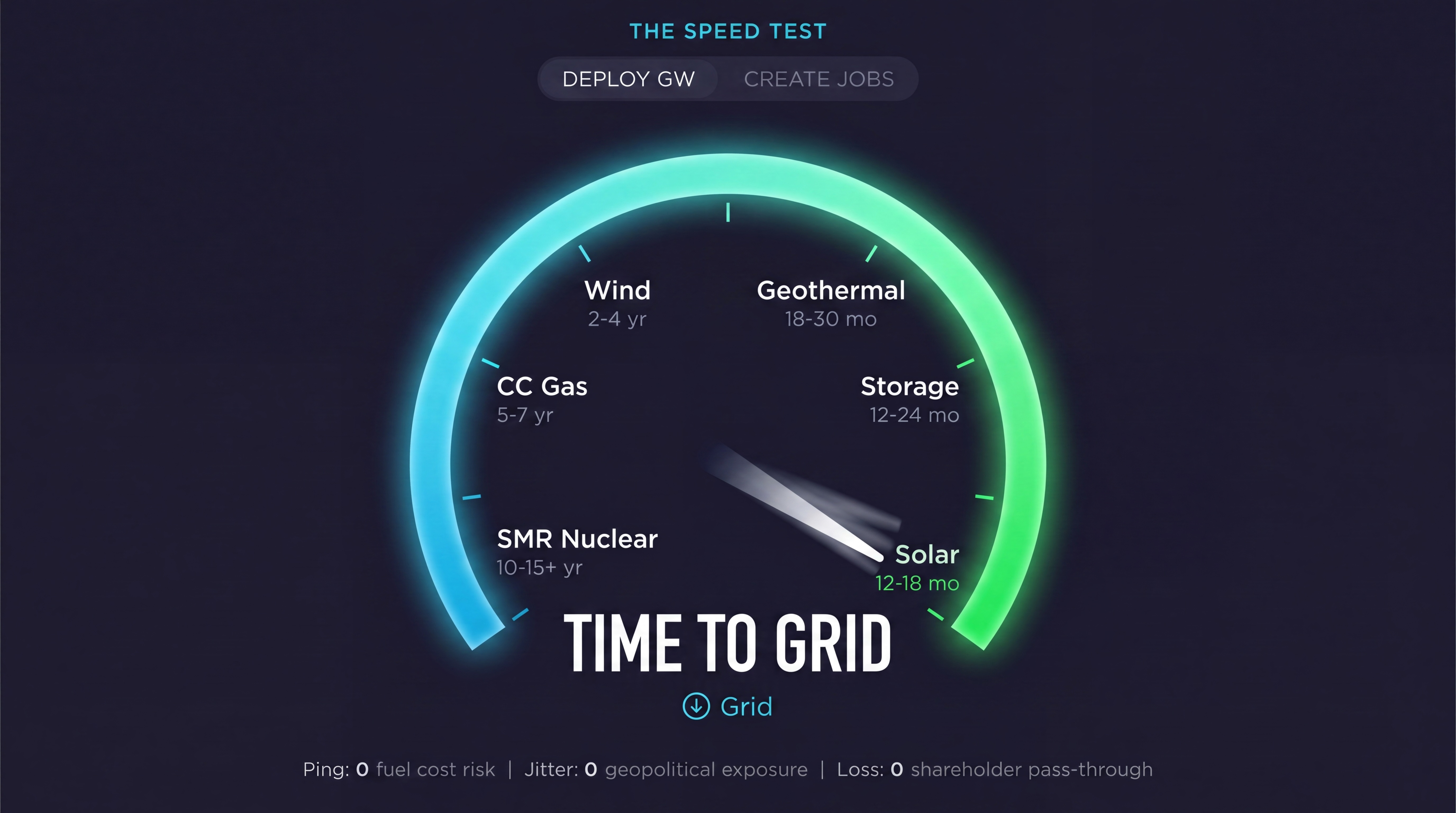
Solar and battery storage can be permitted, built, and interconnected in 12 to 24 months once grid access is secured, though interconnection queue timelines in North Carolina remain a challenge that regulators must address. Compare that with a combined-cycle gas plant (5 to 7 years) or a small modular nuclear reactor (a decade or more, if ever). In a moment when electricity demand is surging, driven by data centers, electrification, and manufacturing growth, the question is not which technology is theoretically superior. The question is what can get online fastest, cheapest, and with the most local control.
The answer is solar and storage. It has been the answer. And the events of March 2026 have made the case louder, clearer, and more urgent than ever.
A Call to Clean Energy Advocates: This Is Our Moment
I write this with urgency because I believe the clean energy advocacy community in North Carolina and across the Southeast has been too quiet in this moment. We have allowed the narrative to be shaped by incumbents and ideologues who are doubling down on the very fuel dependencies that are hurting the people we claim to serve.
We have the data. We have the technology. We have the moral argument. And now, thanks to a missile strike on a gas plant 7,000 miles away, we have the most vivid, undeniable proof that tying our communities to global fossil fuel markets is a choice, not a necessity, and it is a choice that is costing families real money right now.
This is the moment to speak plainly, to show up at Utilities Commission hearings, to write op-eds, to knock on the doors of town council members and county commissioners. Not with jargon. Not with abstractions. With a simple message:
A solar panel on your roof does not care what Iran does to the Strait of Hormuz. A battery in your community does not send a fuel rider surcharge to your mailbox. The fuel is free. The price is locked. And the wealth stays local.
The narrative has been handed to us. It is time to take control of it.
This is the first article in The Price of Dependence, a six-part series from The Current examining how geopolitical volatility, utility business models, and federal policy failures are converging to raise energy costs for North Carolina families, and what a different path looks like.
Next: Article 2: The Speed Test, What Can Actually Come Online in Time?
William Munn III, PhD is the founder and principal of The Alluvial, LLC, a consultancy focused on community-driven clean energy, broadband, and regional economic development across rural North Carolina.


Leave a Reply